The real cost of a holographic display: beyond the hardware price
A procurement model covering content, computing, installation, software, staffing and renewal.
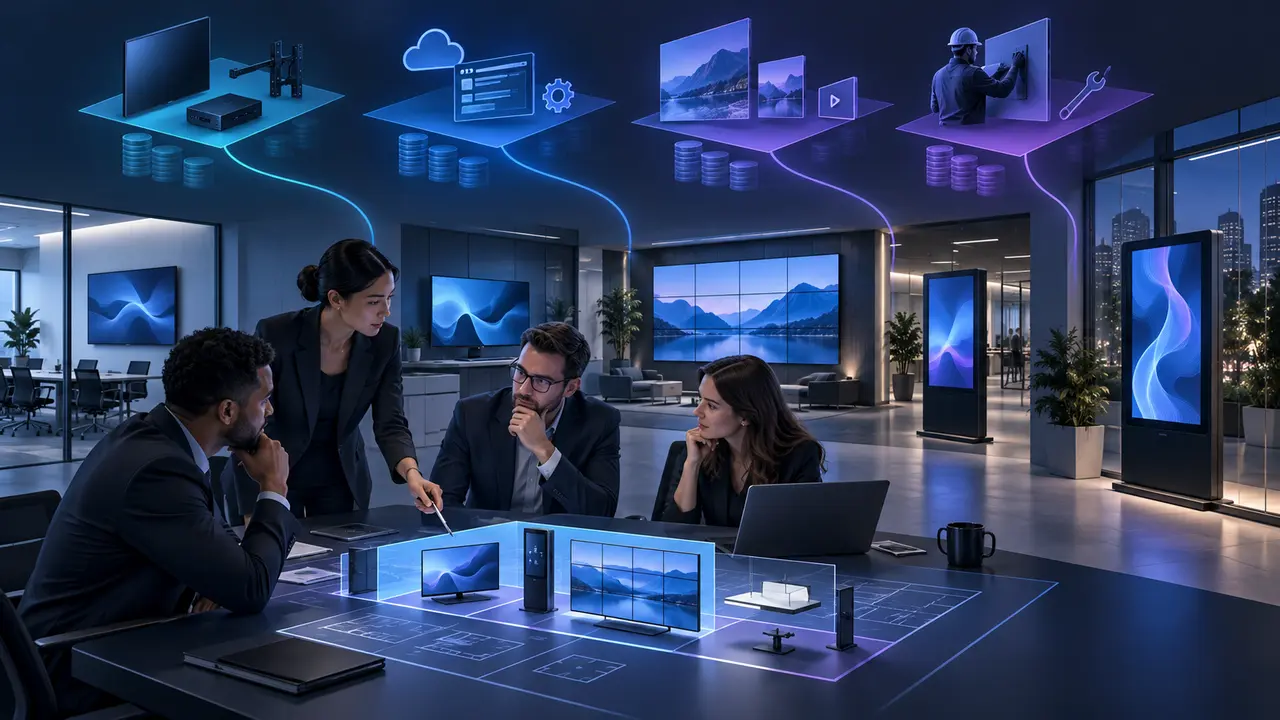 Original HoloNexa editorial illustration. It is not an official product photograph.
This research-based guide uses manufacturer documentation for product facts. Evaluation and buying guidance are independent analysis; it is not presented as hands-on testing.
Hardware is the visible line
The display price is only the easiest number to find. A serious budget also includes the host computer, capture equipment, mounting, enclosure, shipping, duties, installation, networking, insurance and spare equipment.
For enterprise systems, ask whether professional services and travel are required. For glasses, include adapters, corrective lenses, source devices and replacement accessories.
Content is an operating cost
Spatial media often needs more preparation than ordinary video. Budget for 3D modeling, optimization, compositing, testing and versioning across campaigns. A device without fresh content can lose its audience effect quickly.
Clarify software subscriptions, cloud storage, device management, analytics and support renewals. Record which functions stop if a subscription ends.
Use a three-year model
Estimate realistic deployments or active viewing days, then calculate total cost per use. Include staff time and a contingency for content revisions. Compare ownership with rental, managed service and conventional high-quality displays.
The result may still favor spatial technology, especially where presence or 3D understanding drives value. The point is to make that value visible rather than hiding costs outside the purchase order.
Official sources
Specifications, availability and program terms can change. Confirm current information on the linked manufacturer pages.