Light-field displays explained: what you actually see
A practical explanation of multi-view 3D, viewing zones and why glasses-free depth is different from a conventional screen.
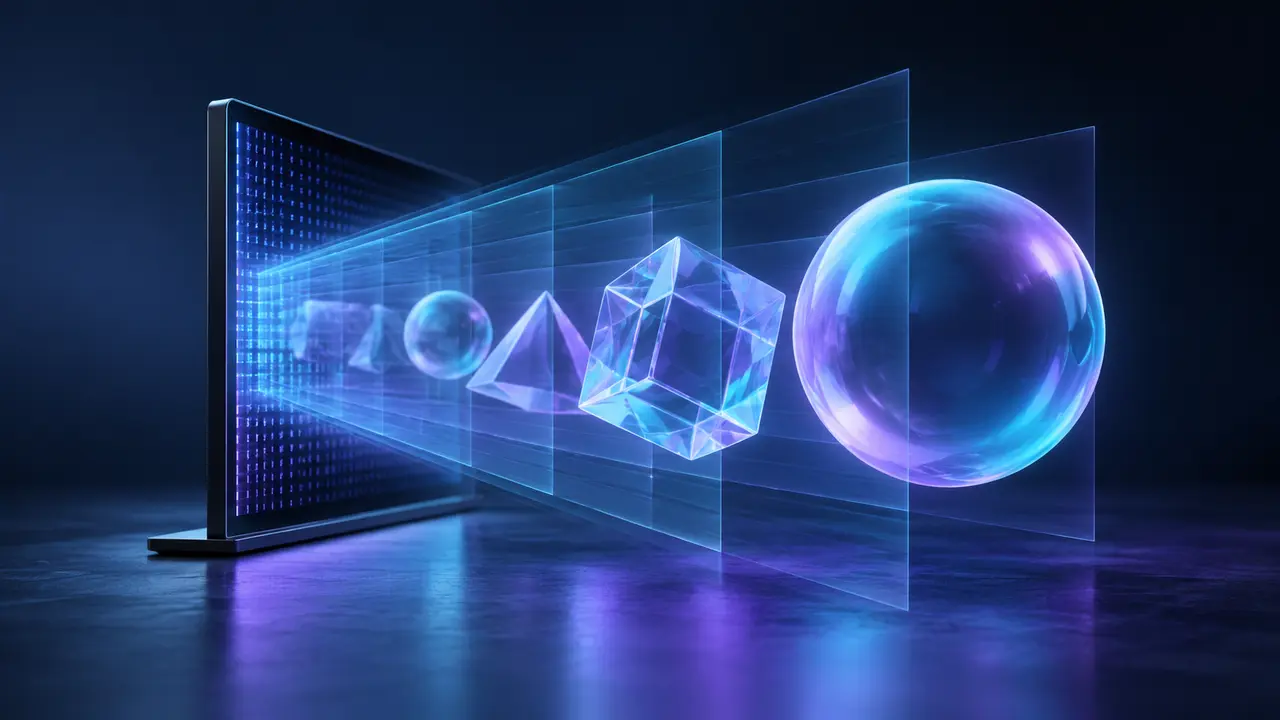 Original HoloNexa editorial illustration. It is not an official product photograph.
This research-based guide uses manufacturer documentation for product facts. Evaluation and buying guidance are independent analysis; it is not presented as hands-on testing.
The useful definition
A light-field display sends different views of a three-dimensional scene in different directions. As you move your head, the perspective changes. That motion parallax is one of the strongest cues your visual system uses to understand shape and depth. Unlike stereoscopic glasses, a shared display can present those views without asking each viewer to wear a headset.
The word hologram is often used loosely in marketing. A light-field display is better described by what it delivers: multiple directional views, generated from 3D content, inside a defined viewing zone. It does not place a free-floating object anywhere in the room, and it cannot ignore the limits of its optical volume.
What determines the experience
The source model, number of rendered views, display resolution, viewing cone, brightness and physical depth all matter. A beautiful 3D asset can look flat when its depth budget is poorly composed; a modest asset can look convincing when scale and motion are handled carefully.
For buyers, the most useful demonstration is your own content at the intended viewing distance. Ask how many people can see the effect at once, what computer is required, which file formats are accepted and whether the workflow supports real-time engines or only pre-rendered media.
Where it fits
Light-field displays are strongest when the subject itself benefits from spatial understanding: medical anatomy, engineering assemblies, scientific data, cultural objects and premium product visualization. They are less compelling when the content is mostly text, flat video or a standard website.
HoloNexa's position is simple: evaluate the visual task first, then the display. A spatial screen should solve a spatial communication problem—not merely add novelty.
Official sources
Specifications, availability and program terms can change. Confirm current information on the linked manufacturer pages.